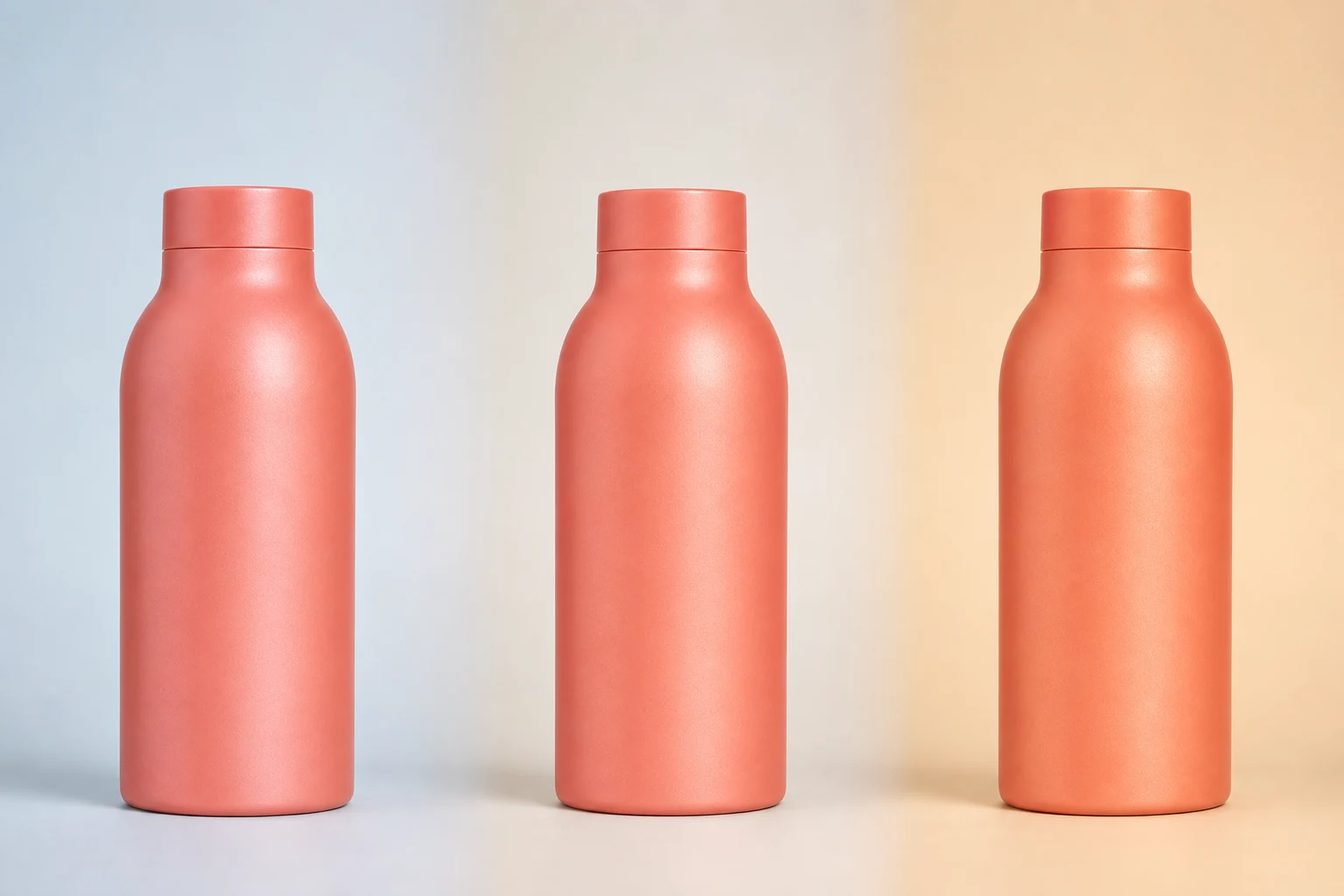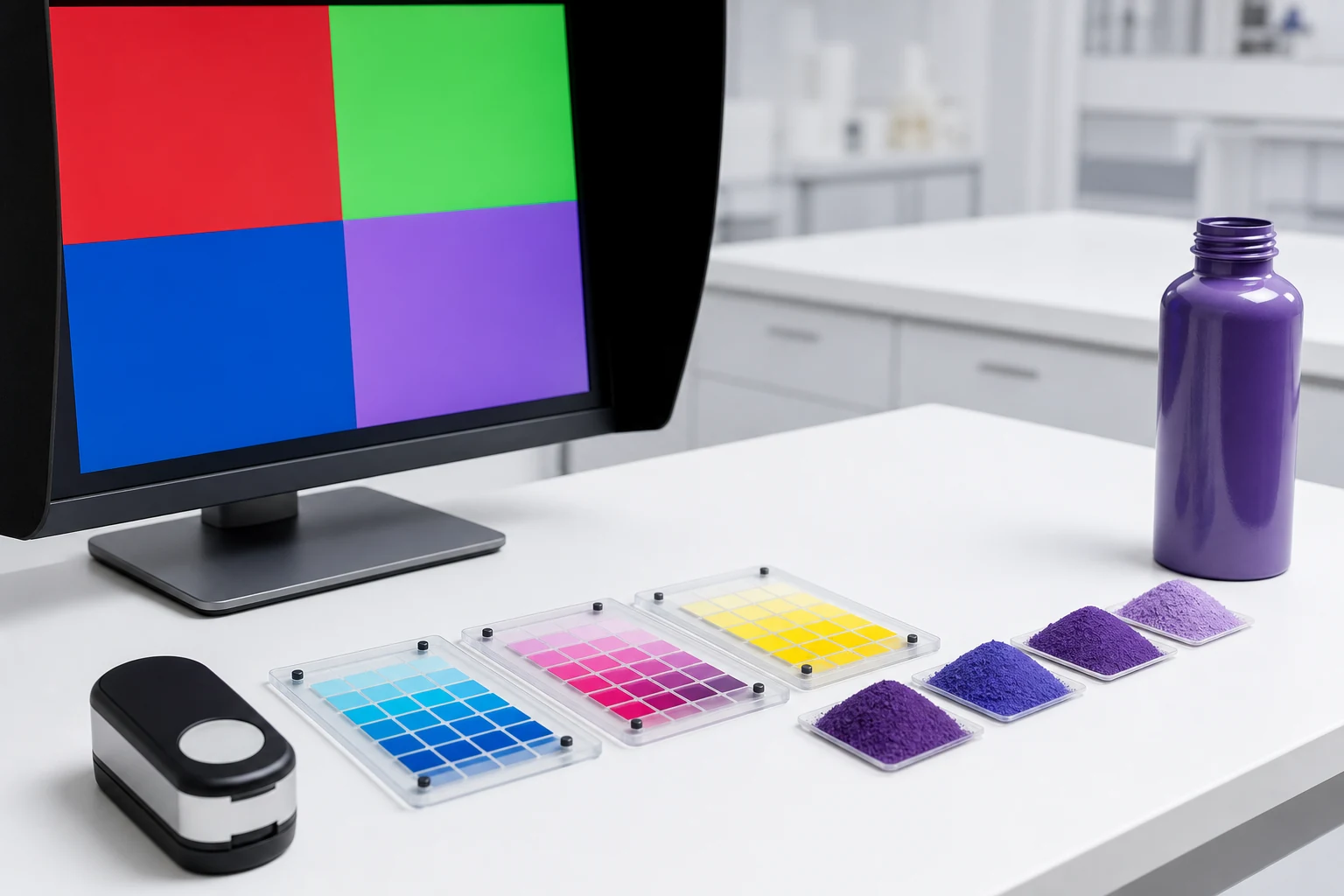
Convert the supplied color into a device-independent comparison space, rank nearby RAL candidates, then approve the best physical RAL and coated sample because no digital conversion can guarantee the final powder appearance.
A brand may begin with a website hex value, an RGB style guide, a CMYK print build, or a Pantone reference. A powder supplier works with physical materials and a finite formulation library. Converting between them is therefore a matching workflow, not a lookup that preserves appearance perfectly.
First identify what the number describes
HEX and RGB usually describe emitted color on a display. Their appearance depends on the RGB color space and display characterization.
CMYK describes device values for a printing condition. The same percentages can print differently with another ink set, substrate, press condition, or profile.
Pantone usually identifies a standardized physical or spectral target within a particular Pantone system. Pantone itself cautions that paint formulations vary with manufacturer, substrate, finish, and application method, so a resulting paint color may not be exact. See Pantone's matching guidance.
RAL identifies a shade in a named RAL collection. The RAL code becomes a practical powder target, but the final film still depends on material and process.
A defensible conversion workflow
1. Normalize the input
Record the source color space and profile. An RGB triplet without “sRGB,” Adobe RGB, or another defined space is ambiguous. CMYK percentages without an output profile or printing condition are similarly incomplete.
2. Convert to a comparison space
Use color management to convert the source into a device-independent space such as CIELAB. The ICC describes its profile connection space as the common interface between independently characterized devices. See ICC color management.
3. Rank available candidates
Compare the target with measured RAL data using an agreed color-difference formula. The result should be a ranked group, not only one hidden answer. Two candidates with similar numerical distance can differ in a way that matters to the brand, such as being warmer, darker, or less saturated.
4. Review physical references
View the nearest candidates beside the brand standard under controlled illumination. Include brand, design, and production stakeholders in the selection.
5. Produce coated samples
Apply the selected candidate using the intended powder chemistry, finish, and substrate. Curvature and sheen can change the perceived relationship enough to alter the final choice.
Why there may be no exact RAL
RAL CLASSIC contains 216 colors and was assembled historically rather than as a uniform sampling of every visible color. RAL DESIGN SYSTEM plus covers a broader, systematically organized space, but it still does not mean every RGB or Pantone target has an exact material equivalent. RAL describes these structural differences in its official FAQ.
| Input | Main uncertainty | Best evidence |
|---|---|---|
| HEX / RGB | Display color space and calibration | Defined profile plus physical brand sample |
| CMYK | Printing condition and substrate | Output profile or printed contract reference |
| Pantone | Pantone system, guide condition, substrate | Current physical chip or spectral target |
| Existing package | Lighting, age, finish, curvature | Measured and visually assessed production sample |
Use Delta E carefully
Color-difference formulas compress a multi-dimensional comparison into one value. That is useful for ranking and control, but it does not explain the direction of the error or the effect of gloss, texture, metallic behavior, or translucency.
State the formula and measurement conditions whenever a tolerance is contractual. For a curved package, define the measurement location and fixture. For metallic or prismatic materials, use a method appropriate to angle-dependent appearance.
What to record in the specification
- Original source and its color space or physical standard
- Selected RAL collection, code, and reference sample
- Nearest alternatives considered
- Intended powder chemistry and supplier reference
- Substrate and base preparation
- Sheen and specialty effect
- Approved physical coated standard
- Measurement and visual evaluation method
That record turns a conversion into a repeatable production decision rather than a screenshot.