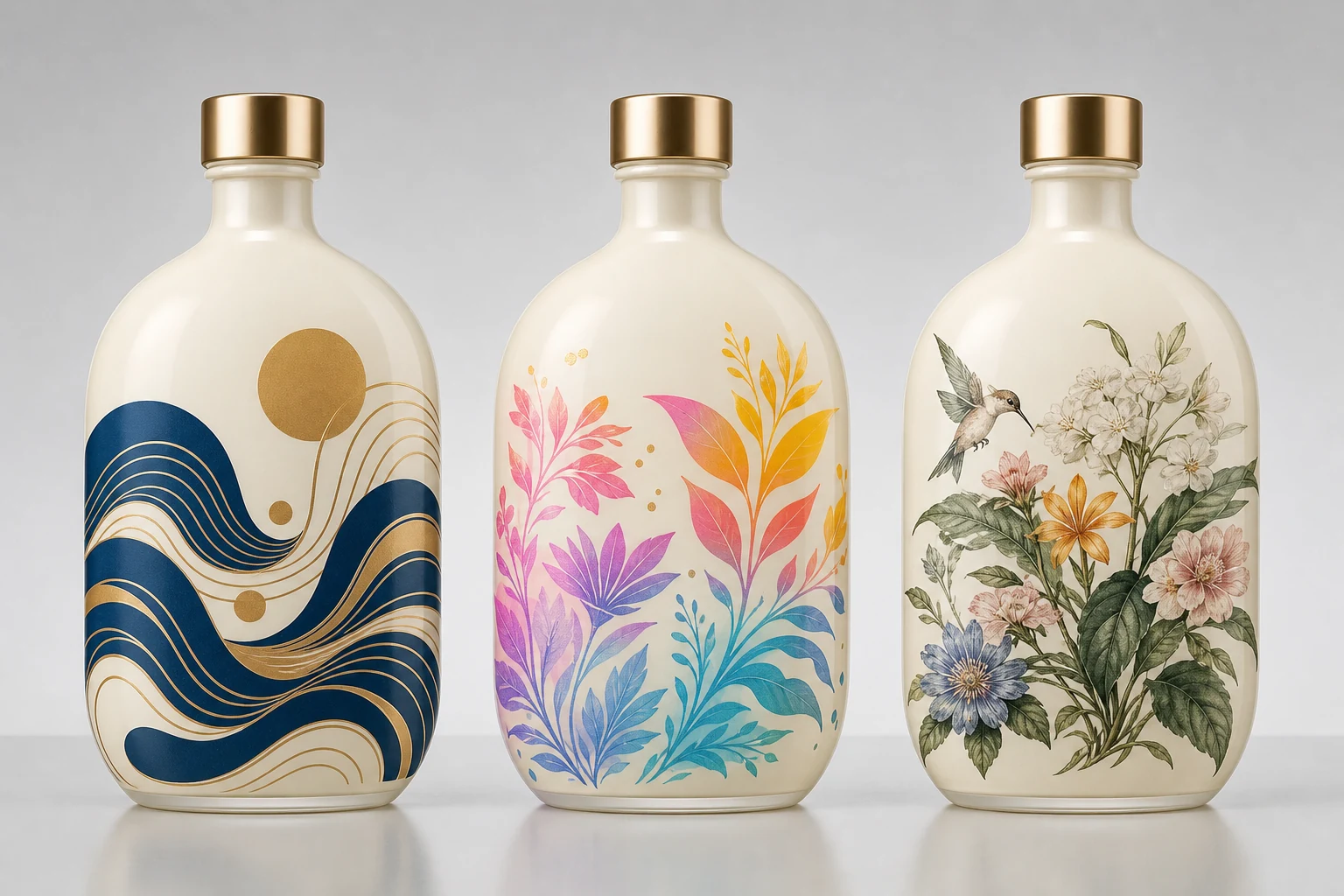
Screen printing is strongest when the package needs durable floating graphics and stable repeat production; labels are strongest when information changes frequently or the design depends on a separate printed material.
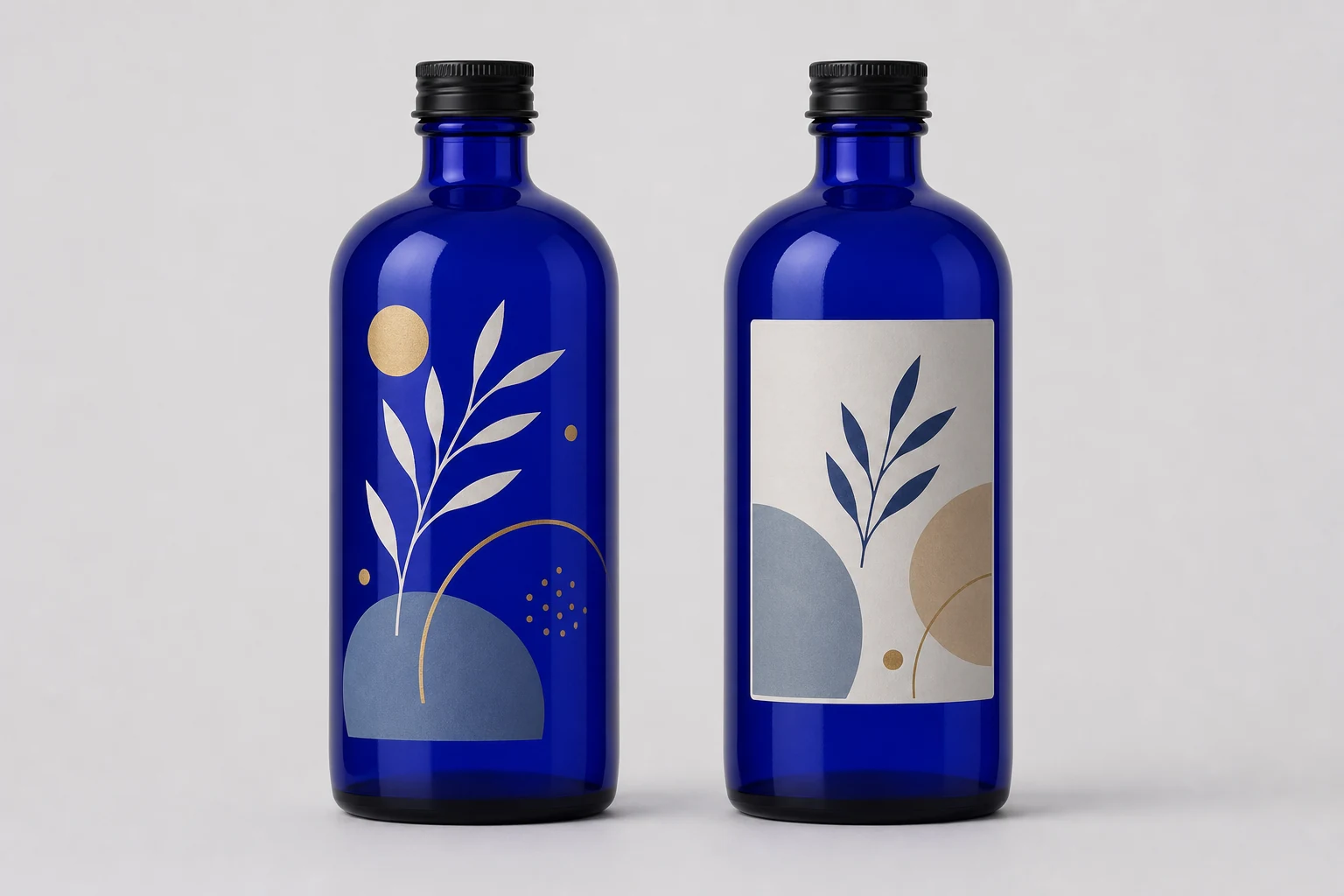
Screen printing places ink directly on the container. A pressure-sensitive label is printed separately and bonded to the container with adhesive. Both can produce excellent packaging, but they create different objects and fail in different ways.
The right comparison is not “premium versus cheap.” It is whether the decoration system supports the intended design, information lifecycle, handling environment, and production model.
The visual distinction
Direct screen print allows individual letters, marks, and shapes to float over the coated surface. There is no label edge and no carrier field unless the artwork intentionally creates one. This is especially useful when the powder background is part of the brand expression.
A label introduces its own material, surface, edge, and adhesive. That can be desirable. A textured paper, clear film, foil, emboss, or complex preprinted construction may create an effect that direct print is not intended to copy.
| Decision | Direct screen print | Pressure-sensitive label |
|---|---|---|
| Visual structure | Floating elements on the package | Printed material applied to the package |
| Typical color logic | Deliberate spot-color separations | Spot or process print on flat stock |
| Change flexibility | New screens and setup may be required | New labels can be produced and stocked |
| Physical edge | None around individual artwork | Label edge remains part of the object |
| Failure modes | Ink wear, adhesion, registration | Edge lift, bubbles, wrinkles, adhesive change |
Durability depends on the whole system
Direct print eliminates label-edge lifting and adhesive failure, but the ink still has to bond to the coating or substrate and withstand handling. A label can be extremely durable when the facestock and adhesive are correctly matched to the container and environment.
Test the actual package against the real exposure: water, oils, alcohol, refrigeration, heat, abrasion, shipping partitions, filling residue, or repeated bathroom handling. Do not choose based on a generic claim that one method is always more durable.
Artwork should be designed for the method
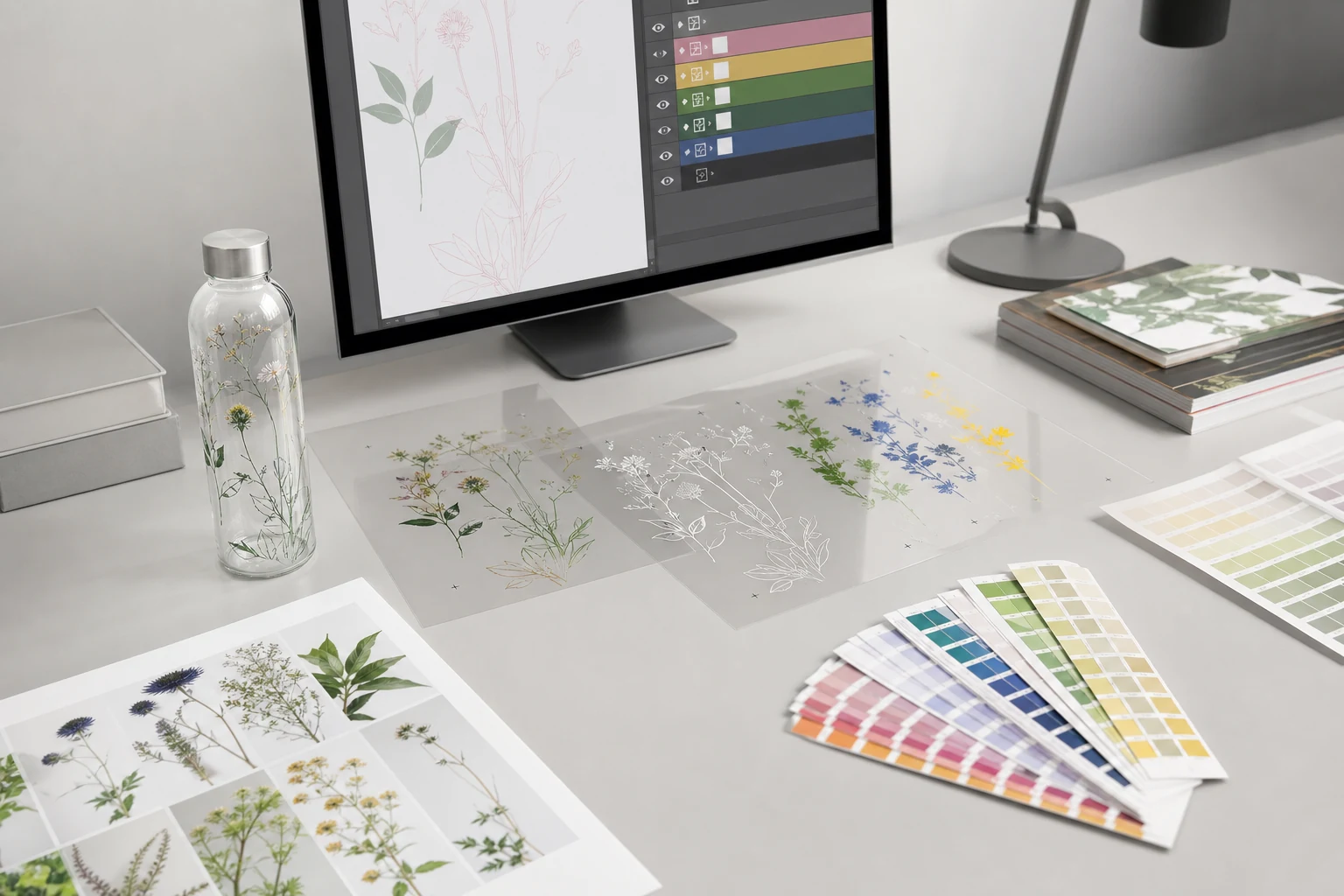
Screen print rewards clear vector forms, controlled line weights, and a limited set of spot colors. Open negative space lets the background participate in the image. Gradients and photographic imagery may be possible through halftones or specialized separations, but they add complexity and may not be the strongest reason to select the process.
Labels can reproduce dense copy, photographs, gradients, variable regulatory panels, and many finishing operations on flat stock. They also provide a predictable white surface when the bottle background would otherwise affect color.
Geometry can decide the method
Both systems prefer a stable decoration area. Screen print must maintain contact, pressure, and registration as the container rotates. Labels must conform without wrinkling, bridging, or lifting.
Taper, compound curves, shoulders, handles, embossing, and abrupt diameter changes reduce usable area. A flat label drawing cannot prove conformance, and a cylindrical screen-print simulation cannot prove registration on a taper. Prototype on the actual container.
Compare total project cost
Screen print typically carries method-specific setup for separations, screens, fixtures, registration, and line preparation. Once established, repeated production can be efficient because no separate label inventory is consumed.
Labels carry plate or digital print costs, die cutting, material, adhesive, freight, inventory, obsolescence, and application. They can be attractive for frequently changing information because the container itself remains common.
Build a quote model that includes:
- Decoration setup and tooling
- Per-unit decoration and material
- Minimum run and spoilage assumptions
- Label inventory and obsolete-version risk
- Changeover labor and production speed
- Inspection, rework, and failure exposure
- Required surface coating beneath either method
A practical selection rule
Choose direct screen print when the surface is meant to remain visible, the design uses a small number of strong colors, the SKU will repeat, and eliminating the label edge matters.
Choose a pressure-sensitive label when copy or language changes frequently, the design depends on label materials or embellishments, or inventory flexibility matters more than a directly integrated surface.
Choose neither until the actual geometry and product environment have been tested.